How APY is Calculated for Grid Orders on Gridtrade.xyz
How APY is Calculated for Grid Orders on Gridtrade
Gridtrade uses a grid trading mechanism to generate yield by systematically buying low and selling high within a predefined price range. The APY (Annual Percentage Yield) of a grid order reflects the compounded return generated from grid execution, trading fees, and price dynamics over time.
1. Price Impact on APY
Price movement is the primary driver of grid trading profitability.
Oscillating Market (Ideal Scenario): When the price fluctuates within the grid range, orders are continuously filled:
- Buy orders execute at lower grid levels
- Sell orders execute at higher grid levels
Each completed cycle locks in a fixed spread profit
Trending Market (Up or Down):
- Uptrend: Assets are gradually sold; the strategy may end up holding more stable assets, reducing future upside exposure
- Downtrend: The strategy accumulates more of the base asset, increasing exposure to further downside
Out-of-Range Price: If the price exits the grid range, no further trades occur, and APY generation effectively pauses
Therefore, APY is maximized when price stays within the grid range and oscillates frequently
2. Impermanent Loss (IL)
Impermanent loss arises due to holding a rebalanced portfolio instead of a static position.
- In grid trading, as price moves:
- The strategy continuously rebalances between two assets
- This leads to a different asset composition compared to simply holding (HODL)
- When IL occurs:
- Strong directional trends (especially one-sided moves)
- The grid strategy may underperform compared to holding the better-performing asset
- Key insight:
- Grid profits (from spreads + fees) can offset impermanent loss
- However, in extreme trends, IL can dominate and reduce net APY
Important Perspective on Impermanent Loss:
Impermanent loss is an unavoidable reality for all similar market-making protocols, such as AMM (Automated Market Makers), grid trading, and others. Most protocols choose not to display actual returns to users, but at Gridtrade , we choose to show the real yield as well as the grid yield after deducting IL, giving users full transparency into their true portfolio performance.
While impermanent loss is closely tied to a user’s trading strategy, price trends are inherently unpredictable. Grid trading allows users to face price volatility more calmly and systematically, capturing profits from market oscillations regardless of market direction.
APY shown on gridtrade typically reflects realized trading gains, but users should consider IL for true portfolio performance
3. Compound Mode (Auto-Reinvestment)
Gridtrade supports a compound mode, which significantly affects APY.
How it works:
- Profits from grid spreads and trading fees are automatically reinvested
- New funds are continuously added back into the grid
- This increases the effective position size over time
Impact on APY:
- Converts simple returns into compounded returns
- Accelerates growth, especially in high-frequency trading environments
Without compound mode:
- Profits remain idle unless manually reinvested
- APY behaves more like a simple yield
Compound mode is a key factor in achieving higher APY on gridtrade
4. How Gridtrade Calculates Yield (APY)
The APY on gridtrade is derived from the actual performance of a grid order and annualized.
Core Components of Yield
Grid Profit (Spread Income): Profit generated from each completed buy-low / sell-high cycle
Trading Fee Income: Fees earned (if applicable in the protocol design)
Compounded Gains: Reinvested profits increase capital base over time
General APY Calculation Logic
APY is calculated by annualizing the return over the running time of the grid:
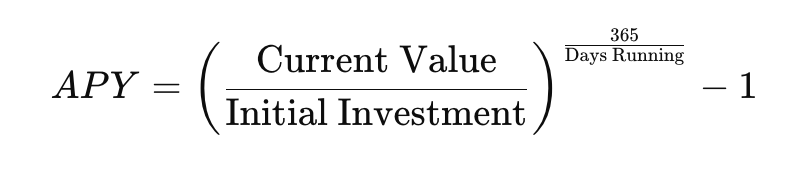
Where:
- Current Value = total value of assets in the grid (including realized + unrealized PnL)
- Initial Investment = capital deposited when creating the grid order
- Days Running = duration the grid has been active
Important Notes
APY is dynamic and changes with:
- Market volatility
- Trade frequency
- Grid density
- Price direction
Reported APY may:
- Include realized profits
- Exclude or not fully reflect impermanent loss depending on UI design
Higher APY does not always mean lower risk:
- Narrow grids → higher frequency, higher APY, but more sensitive to price breakouts
- Wide grids → lower APY, but more stable
Summary
The APY of grid orders on gridtrade is driven by:
- Price behavior (range-bound vs trending)
- Impermanent loss effects
- Compounding of grid profits and fees
- Annualization of actual returns over time
In essence, grid trading performs best in volatile, sideways markets, and compound mode amplifies returns by continuously reinvesting profits into the strategy.